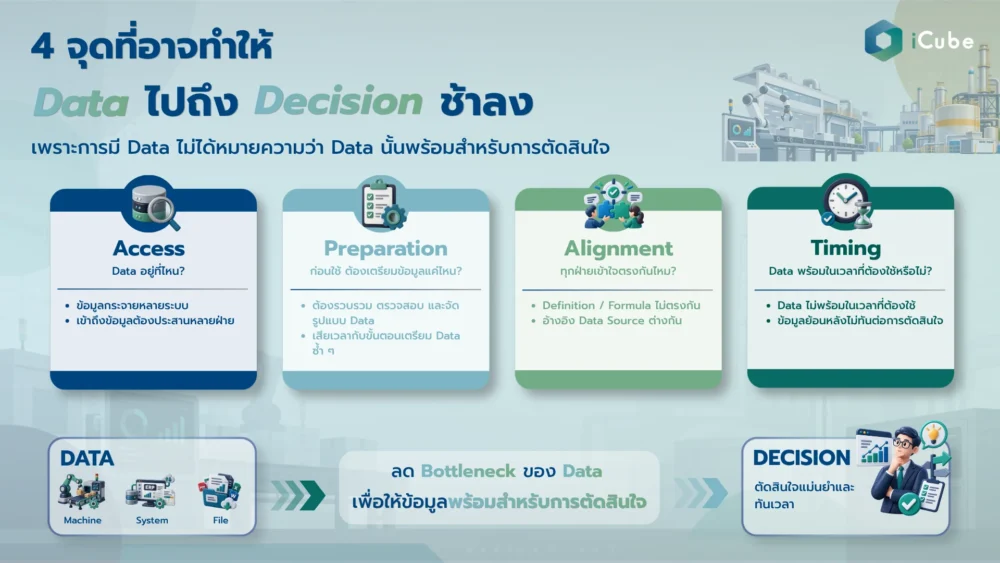




Currently, factories generate data from many parts of their operations — machines, production systems, ERP, MES, right down to the Excel files each department uses in its daily work.
But having more data doesn’t always mean it can be used to make decisions faster. What matters isn’t just “how much data do we have,” but “how ready is that data to actually be used.”
Here are 4 points where data often gets stuck before it can reach a decision:
1. ACCESS — You have data, but can’t reach it immediately
Data needed for a decision is often scattered across multiple systems and departments — production data in one system, downtime data in another, while quality or inventory data sits somewhere else entirely. When someone needs to use the data, the team often has to start by figuring out where it lives and who owns it before any analysis can even begin.
Starting point: Clearly identify what data matters to the organization, where it lives, who owns it, and who needs access to it.
2. PREPARATION — You have data, but it still takes time to prepare before use
Even once data is accessible, many reports still need to be exported, merged, checked, or reformatted before they’re usable. If these steps happen routinely, a chunk of the team’s time keeps going into preparing data instead of analyzing and using it.
Starting point: Map out the steps that repeat regularly, and identify which ones can be standardized or automated.
3. ALIGNMENT — You have numbers, but do departments actually agree on them?
Even when everyone is talking about the same KPI, if each department uses a different data source, formula, or definition, the resulting numbers won’t match. Time that should go toward analyzing “what happened and what should we do next” instead gets spent going back to check “which set of numbers is correct.”
Starting point: Clearly define the definition, formula, and data source for key KPIs so every department can work from a shared understanding.
4. TIMING — The data is correct, but is it ready when it’s actually needed?
Not all data needs to be real-time — different use cases need different data speeds. A monthly report doesn’t need the same speed as data used to adjust production plans mid-day, or data used to flag equipment anomalies. The goal isn’t making all data as fast as possible, but making it ready at the right time for how it will be used.
Starting point: Start with the question “how fast does this decision actually need the data to be?” — then set update frequency accordingly for each use case.
Before adding more technology, look at where your data is actually stuck
The fix doesn’t have to start with adding a new dashboard or overhauling the whole system. It can start with understanding:
What decision do we need data for? → What data does that require? → Is the data stuck at Access, Preparation, Alignment, or Timing? → Where should process or technology help?
Once an organization can clearly see its bottlenecks, it becomes much easier to plan a data strategy and choose the right technology for the actual problem. Because the goal of data management isn’t just making the factory “have more data” — it’s making sure “the data you have is ready the moment you need to decide.”