





When discussing the adoption of Artificial Intelligence (AI) in manufacturing, many people may think of cloud-based AI systems that can process large volumes of data and connect multiple systems through a centralized platform.
In practice, however, AI does not always need to run on the Cloud. Some applications require data to be processed within the factory, while others need AI to analyze information and respond quickly near the machines themselves.
The key question is not simply “Should our factory use AI?” but also “Where should AI run to best support the task?”
Understanding the differences between Cloud AI, On-Premises AI, and Edge AI can help manufacturers choose an approach that aligns with their data requirements, production systems, and operational constraints.
Does All AI Need to Run on the Cloud?
The answer is no.
Determining where AI should run depends on several factors, including data volume, response time, data security, network connectivity, and the nature of the application.
Consider two different scenarios in a manufacturing environment.
Scenario 1: AI for Production Data Analysis
A factory wants to analyze historical production data from multiple production lines to identify patterns of abnormalities or support future production planning.
This type of application may not require a response within a fraction of a second. Instead, it needs a system that can efficiently collect and process data from multiple sources.
Scenario 2: AI for Detecting Defects on a Production Line
A factory uses cameras and AI to inspect products during manufacturing. When a defective product is detected, the system must send a signal to remove it before it passes the inspection point.
This application requires fast processing and response times, as delays could affect production line operations.
Although both scenarios use AI, their system requirements are significantly different.
Deciding whether AI should run on the Cloud, within the factory, or close to the machines should therefore begin with understanding the task rather than selecting the technology.

Three AI Deployment Approaches Based on Where Processing Takes Place
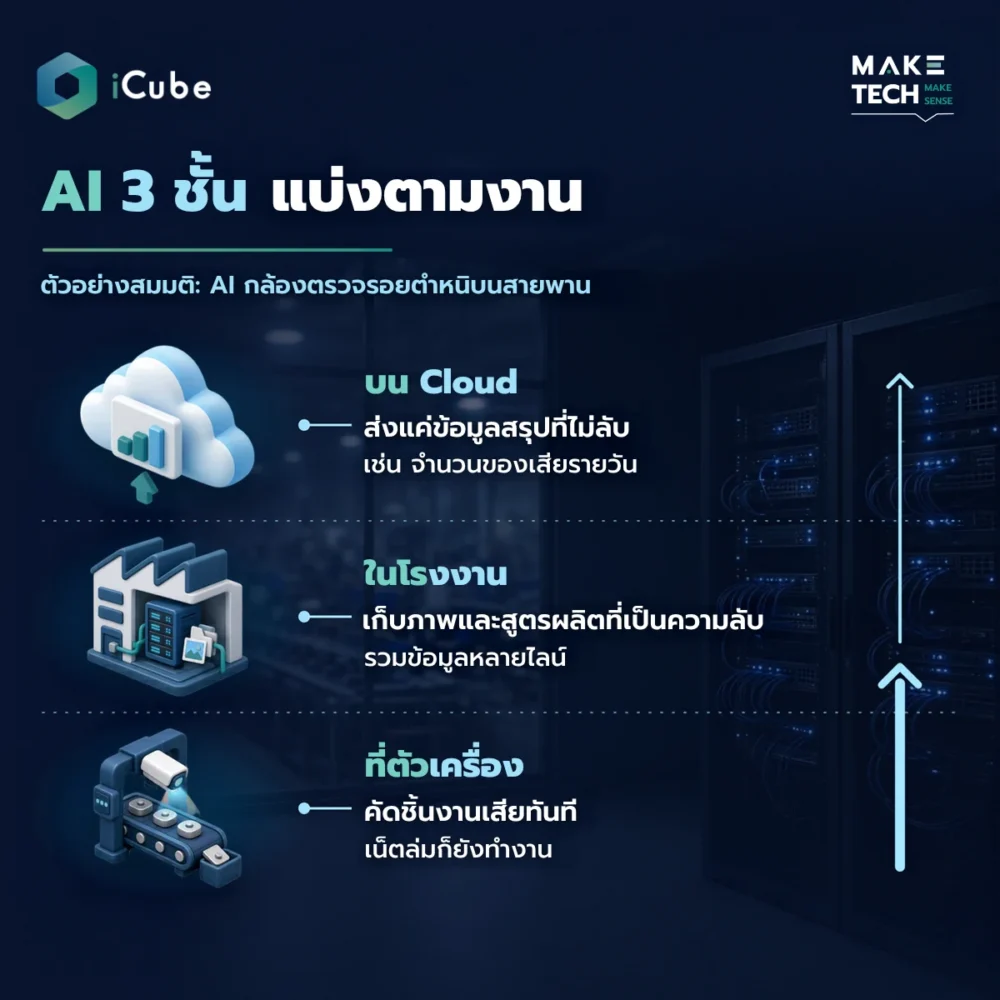
AI deployment in manufacturing can generally be divided into three main approaches: Cloud AI, On-Premises AI, and Edge AI.
1. Cloud AI – Processing in the Cloud
Cloud AI uses computing resources provided by cloud service providers to process data. Manufacturers can send relevant data to the Cloud for processing and use the results for analysis or decision-making.
This approach is suitable for applications that require scalable computing resources, as well as those that involve analyzing data from multiple sources or manufacturing sites.
Manufacturing Use Case
A company operating multiple factories wants to consolidate production data to analyze defect trends, compare production performance, and identify patterns that could lead to process improvements.
Cloud AI allows data from different factories to be processed together without requiring extensive AI computing infrastructure at every manufacturing site.
However, implementing Cloud AI requires careful consideration of network connectivity, data transmission time, operating costs, and data security requirements.
2. On-Premises AI – Processing Within the Factory
On-Premises AI refers to AI systems deployed on servers or computing infrastructure managed by an organization within its factory or data center.
This approach gives organizations greater control over where their data is stored and processed, without requiring all information to be sent to an external cloud environment.
Manufacturing Use Case
A factory holds confidential production formulas, technical documents, and process information that it does not want to send to external systems for processing.
The factory may choose to deploy AI within its own infrastructure, allowing employees to search documents or ask questions about information they are authorized to access.
This approach is particularly suitable for organizations with strict data governance or security requirements.
However, On-Premises AI also requires proper infrastructure management, system maintenance, software updates, and access control.
3. Edge AI – Processing Close to Machines
Edge AI refers to AI processing performed on devices or computers located close to the source of the data, such as quality inspection cameras, machines, or edge computing devices.
One of its main advantages is that it reduces the need to send all data to a centralized system for processing. This can enable faster responses in applications that require low latency.
Manufacturing Use Case
A production line is equipped with cameras that capture images of products. AI analyzes these images to identify defects or abnormalities.
When AI detects a product that does not meet the required quality criteria, the inspection result can be sent to a control system to remove the defective product from the production line.
Processing data close to the machines reduces the time required to transmit information to a centralized system and receive the results.
However, Edge AI may have limited computing resources, making it important to select AI models and hardware that are appropriate for the application.
How Should Manufacturers Choose the Right AI Deployment Approach?
Choosing an AI deployment approach should not begin with asking which technology is best. Instead, manufacturers should first understand what each application requires from AI.
Before making a decision, manufacturers can consider three key questions.

1. How Quickly Does AI Need to Respond?
Not every application requires real-time results.
When AI is used to analyze historical data, summarize reports, or support production planning, longer processing times may be acceptable.
However, when AI needs to detect abnormalities on a continuously moving production line, the time between receiving data and delivering a result can be critical.
Manufacturers should therefore determine how long each application can wait for a response before selecting where AI processing should take place.
2. Can the Data Be Sent Outside the Factory for Processing?
Different types of manufacturing data may be subject to different data management requirements.
Some information can be processed in the Cloud, while sensitive data, such as production formulas, customer information, or confidential process data, may be subject to restrictions on external processing.
If data must remain within the organization, On-Premises AI or Edge AI may be more suitable options. Appropriate security measures must also be considered as part of the system design.
3. Does AI Need to Connect Directly to Machines?
If AI is used to analyze data, generate reports, or support decision-making, the processing system may not need to be located close to the machines.
However, if AI needs to receive data from cameras, sensors, or production line equipment and quickly return results to a control system, processing closer to the machines may be more appropriate.
Direct machine connectivity does not necessarily mean that Edge AI is required. Response time, network reliability, and control system requirements should also be taken into consideration.
Does a Factory Need to Choose Only One AI Deployment Approach?
Not necessarily.
In practice, manufacturers can combine different AI deployment approaches based on the requirements of each application. This is known as a hybrid approach.
For example, a factory may use Edge AI to inspect products on a production line, an on-premises system to collect and manage sensitive data, and Cloud AI to analyze production trends using information that is approved for external processing.
Each system serves a different purpose, while its outputs can be connected and used to support manufacturing operations.
The goal is not to deploy AI everywhere in the factory, but to deploy it where it can effectively support the work being performed.
Conclusion: Choose AI Based on the Task, Not the Entire Factory
Cloud AI, On-Premises AI, and Edge AI each have their own advantages and limitations.
Cloud AI is suitable for applications that require scalable computing resources and data analysis across multiple sources. On-Premises AI is suitable for applications that require greater control over infrastructure and internal data processing. Edge AI is suitable for applications that require processing close to the data source and fast response times.
Before implementing AI, manufacturers should begin by understanding their operational requirements, data needs, and existing system constraints.
Ultimately, the right AI solution is not necessarily the one that uses the most advanced technology, but the one that best supports the factory’s processes and operational goals.