



AI is becoming an increasingly important part of everyday operations, from analyzing data and detecting anomalies to supporting decisions across business processes. In manufacturing, more companies are adopting AI to improve efficiency and reduce repetitive workloads.
But just because AI can process information quickly doesn’t mean its results are always accurate, or that every decision should be left entirely to AI.
In real-world operations, some decisions require more than data analysis. They also depend on practical experience, an understanding of what’s happening on the factory floor, and careful consideration of the potential consequences.
This is where Human-in-the-Loop (HITL) comes in. It introduces human involvement at key points in an AI-driven process, rather than leaving every step to automation.
What Is Human-in-the-Loop (HITL)?
Human-in-the-Loop (HITL) is an approach to designing AI workflows in which humans remain involved in specific stages of the process. Their role may include reviewing AI-generated results, providing feedback, or making decisions when human judgment is needed.
This doesn’t mean people need to review every result. Instead, organizations can define when AI is allowed to proceed automatically and when a case should be referred to a human for further review.
For example, human review may be triggered when an AI model produces a low-confidence result, encounters unfamiliar data, or makes a recommendation that could significantly affect operations.
Consider an AI system that inspects manufactured parts using images. If it detects an unusual mark on a surface but cannot confidently determine whether it is a genuine defect or simply a reflection, the system can flag the part for an operator to review.
In this situation, AI handles the initial inspection, while a human steps in when additional context or judgment is needed.
HITL is therefore not about replacing AI with manual work. It is about defining where human expertise adds value and how both can work together effectively.
How Does Human-in-the-Loop Work?
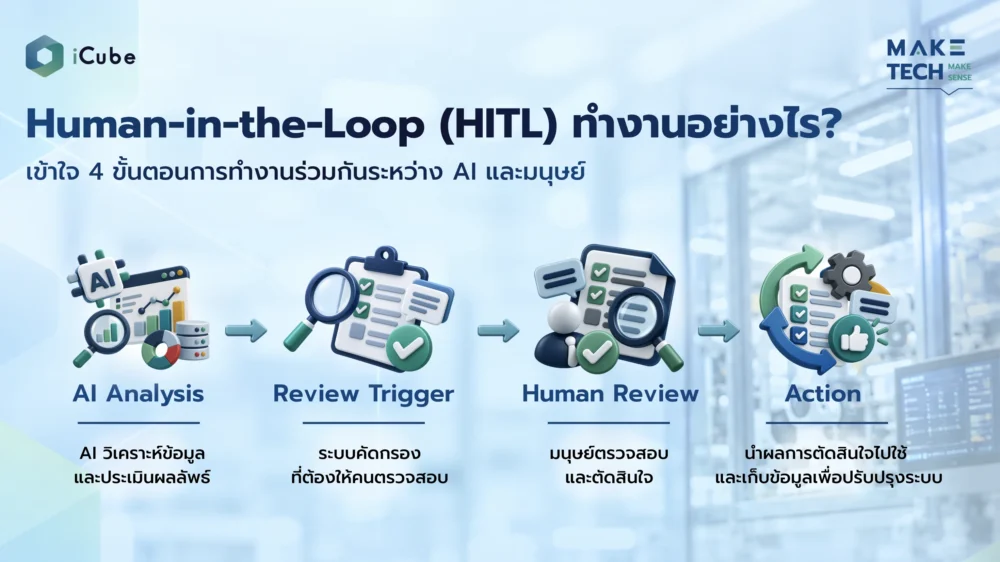
The way HITL is implemented varies depending on the AI system and the process it supports. However, a typical workflow can be illustrated through four main stages.
1. AI Analysis – Analyzing the Data
The process begins with AI analyzing data for a specific task, such as inspecting product images, evaluating machine data, or identifying anomalies in production processes.
Based on this analysis, AI generates an initial result. For example, it might flag a potential defect in a manufactured part or detect an unusual pattern in machine performance.
That result then moves to the next stage of the workflow.
2. Review Trigger – Identifying Cases That Need Human Review
Once AI has produced a result, the system determines whether it can proceed automatically or requires further human review.
This decision may depend on predefined conditions, such as the model’s confidence level, the type of anomaly detected, or the potential risk of an incorrect decision.
Results that meet the established criteria may proceed automatically, while cases that require additional review are directed to the appropriate person.
3. Human Review – Reviewing and Making Decisions
When a case is flagged for review, a person evaluates the AI’s findings alongside relevant operational information.
For example, a quality control inspector may receive an alert about a potential defect. Before deciding whether to accept or reject the part, the inspector can examine the mark, compare it against quality standards, and assess the condition of the product.
This allows the decision to take into account not only the AI’s analysis but also the experience and practical knowledge of the people working with the process.
4. Action & Feedback – Taking Action and Recording Feedback
Once the review is complete, the decision is applied to the workflow. This might involve accepting a product, rejecting a defective part, or sending it for further inspection.
If the system supports feedback collection, the results of human reviews can also be recorded and analyzed to identify where AI makes mistakes or where improvements may be needed.
However, collecting feedback does not mean the AI model automatically learns or improves in real time. Any improvements depend on how the organization develops, tests, and updates its models.
Example of Human-in-the-Loop in Manufacturing
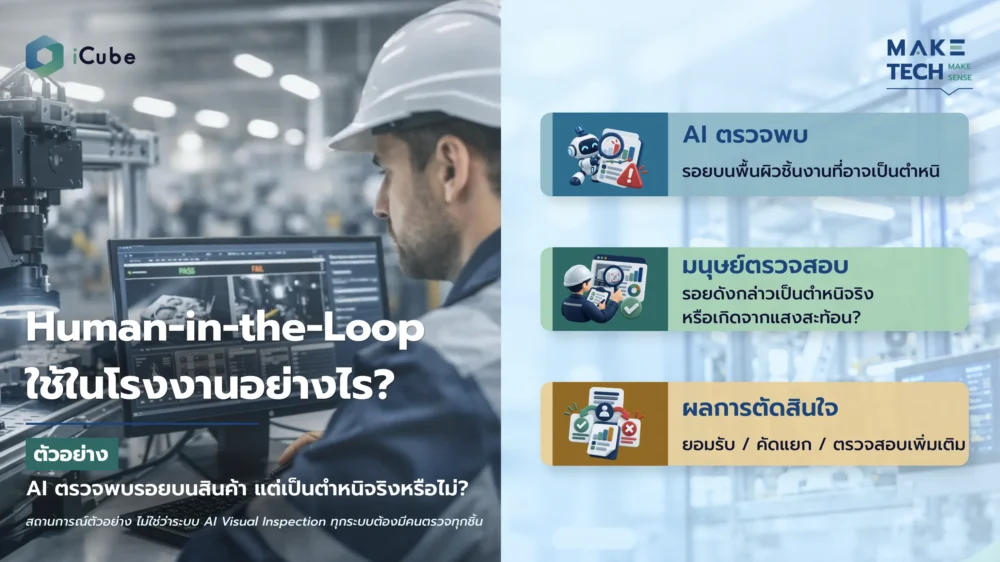
To see how HITL works in practice, consider a factory using AI Visual Inspection, where cameras and AI models are used to inspect product quality.
During inspection, the system detects an unusual mark on the surface of a manufactured part and identifies it as a potential defect.
However, in real production environments, not every unusual mark is a genuine defect. Some may result from lighting conditions, camera angles, or the material’s surface characteristics.
If the system immediately rejects every part it flags, products that actually meet quality standards could be removed unnecessarily.
On the other hand, if AI fails to detect a genuine defect, a nonconforming product could move on to the next production stage.
HITL can help address these situations by introducing human review where needed. The process can be divided into three parts:
AI Detection: The system analyzes an image and identifies a surface mark that may indicate a defect.
Human Review: A quality inspector examines the mark against established quality standards to determine whether it is a genuine defect or the result of another factor, such as light reflection.
Final Decision: The inspector decides whether to accept the part, reject it, or send it for further inspection based on the defined quality criteria.
With this approach, AI can continue inspecting large volumes of products, while operators focus on cases that require additional review rather than checking every part manually.
The exact review process will depend on the AI system’s capabilities, the factory’s quality standards, and the level of risk the organization is prepared to accept.
Why Does AI Still Need Human Oversight?
AI can analyze data and support a wide range of tasks, but it still has limitations that organizations need to consider before using it in real-world operations.
1. AI Can Still Make Mistakes
AI accuracy depends on several factors, including the data used to develop the model, the quality of incoming data, and how closely real operating conditions match the conditions represented in its training data.
For example, an AI inspection system that performs well under one lighting setup may produce different results when lighting conditions, camera angles, or materials change.
This is why organizations need to look beyond overall accuracy figures and assess whether an AI system performs reliably enough under actual operating conditions.
2. Some Decisions Require Operational Context
AI can recognize patterns and analyze the information it receives, but it may not have access to every factor affecting a situation.
In manufacturing, a decision might also depend on machine conditions, production history, process limitations, or other information that has not been included in the AI system.
The experience and practical understanding of operators and engineers therefore remain important, particularly when a decision requires more than interpreting the available data.
3. Some Errors Can Have Significant Consequences
In manufacturing, an incorrect decision may affect more than a single product. Depending on the situation, it could influence product quality, production continuity, or worker safety.
For higher-risk activities, requiring human review or approval before an action is taken can be one way to manage potential risks.
However, human involvement does not guarantee error-free decisions. People can make mistakes too.
An effective HITL process therefore needs clear review criteria, sufficient information to support decisions, and well-defined responsibilities for everyone involved.
Which AI Tasks Should Include Human Review?
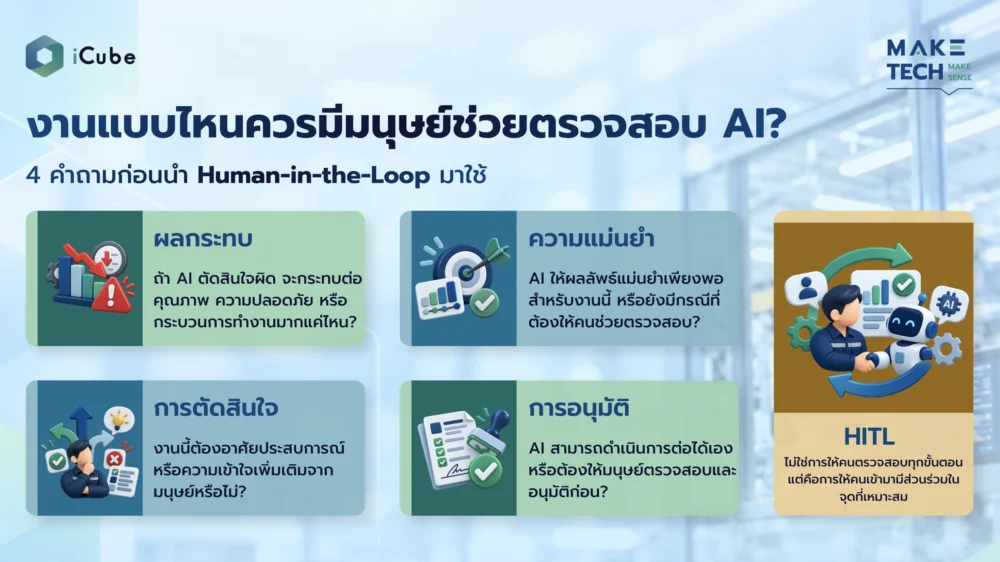
Not every AI-powered task requires human review at every stage.
Some tasks follow predictable patterns, involve relatively low risks, and can be automated under clearly defined conditions.
For more complex activities, or decisions that could significantly affect production, organizations need to determine how much autonomy AI should have and where human involvement is necessary.
The following four questions can help guide that assessment.
1. Impact – What Happens If AI Makes the Wrong Decision?
Consider how an incorrect AI result could affect product quality, safety, or production continuity.
If the consequences could be significant, introducing human review before the result is acted upon may be necessary to reduce risk.
2. Accuracy – Is AI Reliable Enough for This Task?
An AI system may perform well under normal conditions but still produce uncertain or incorrect results in certain situations.
Organizations should assess whether its performance is sufficient for the intended task and identify which results or conditions should trigger additional human review.
3. Decision-Making – Does This Task Require Human Experience?
Some decisions cannot be made using AI-generated information alone.
They may require practical experience, an understanding of the current operating environment, or additional information that the AI system cannot access.
In these situations, involving people in the decision-making process can provide valuable context and support more appropriate decisions.
4. Approval – Can AI Take Action on Its Own?
AI may be capable of analyzing a situation and recommending an action, but that does not necessarily mean it should execute the recommendation automatically.
For example, if AI recommends changing machine operating parameters that could affect product quality or safety, a factory may require an engineer to review and approve the proposed settings before they are applied.
These four questions are not universal rules for every AI system. Instead, they provide a starting point for deciding how much autonomy AI should have and where human oversight is needed.
Conclusion: Human-in-the-Loop Doesn’t Mean Reviewing Every Step
Adopting AI does not have to mean choosing between full automation and having people review every result.
Human-in-the-Loop offers a way to design workflows that combine the capabilities of AI with human expertise. AI can analyze data, detect anomalies, and reduce repetitive work, while people provide oversight and make decisions when additional experience, context, or risk assessment is required.
The key to HITL is not having humans check every step. It is knowing when AI can proceed independently and when human involvement is necessary.
For manufacturers, getting value from AI is not simply about adopting more advanced technology. It is also about designing systems in which AI, people, and production processes work effectively together.