



What Is Real-Time Data? And How Real-Time Does a Factory Actually Need to Be?

Using data in manufacturing isn’t only about volume or accuracy – when the data becomes available is just as important to decisions and operations.
As factories connect more data from machines, sensors, PLCs and other systems, the concept of real-time data comes into play across everything from production status monitoring to abnormality alerts to process control.
That said, making every type of data real-time doesn’t automatically create more value, because each type of data serves a different purpose and a different decision window.
So the key question isn’t “is this data real-time or not?” – it’s “how quickly does this data need to be available to fit the decision and the work it supports?”
What Is Real-Time Data?
Real-time data is data that is generated, collected and sent for processing continuously, so that it is ready to use close to the moment the event occurs.
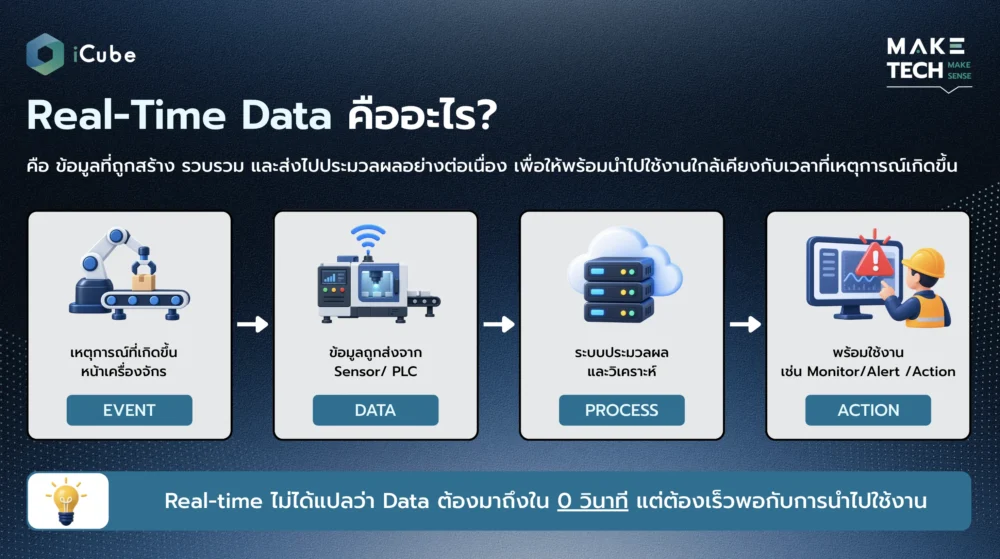
In a factory context, the process typically starts with an event on a machine or in a production process. A sensor or PLC captures and transmits that data into a system for processing, and the result is then used for monitoring, alerting or a related action.
The flow can be summarized as: EVENT → DATA → PROCESS → ACTION
For example, when a system detects a change in a machine parameter, data from the shop floor is sent in for processing, and the result is used to display status, raise an alert, or support a follow-up action.
However, “real-time” doesn’t mean data delivered with zero delay. It means data that arrives fast enough for the purpose it serves – which is why not every type of data in a factory needs the same speed.
How Real-Time Does a Factory Need to Be?
Data speed requirements should start from the purpose the data serves.
If the data supports work that must respond to events immediately, the speed requirement is naturally higher than for data used to analyze past performance.
Broadly, use cases fall into three groups.
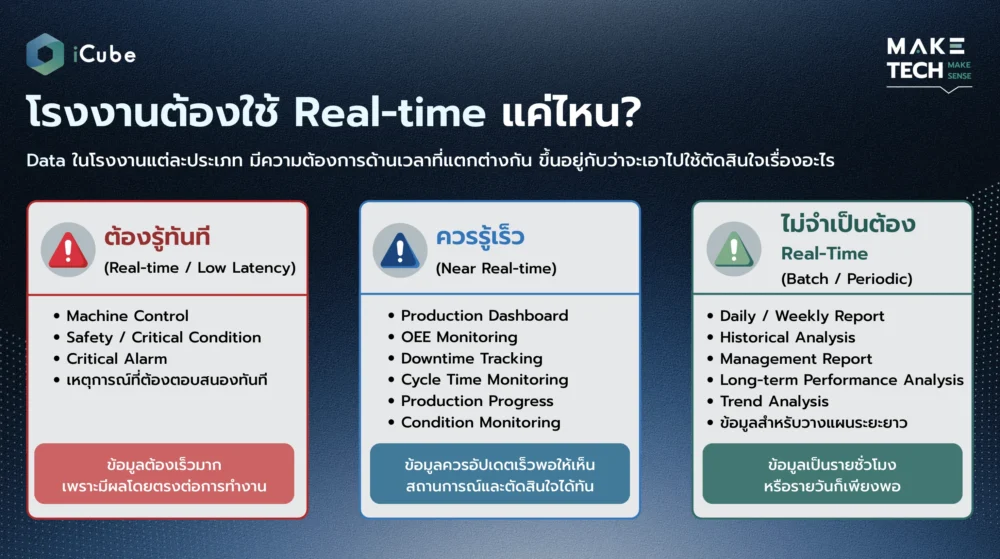
1. Real-Time / Low Latency: When You Must Respond Immediately
Some work is tied directly to the live state of a machine or process:
- Machine control
- Safety or critical conditions
- Critical alarms
- Abnormality detection requiring immediate action
For these use cases, data delay directly affects how well the system or the operator can respond. If an event requires immediate handling but the data arrives after the event has passed, that data can no longer support the decision effectively.
Data in this group therefore prioritizes low latency – minimizing the time between the event occurring and the data being ready to use.
2. Near Real-Time: When You Need to See the Situation Soon Enough to Decide
Many monitoring and production-tracking use cases need current data – but that doesn’t mean every value must update instantly, every fraction of a second.
Examples:
- Production dashboards
- OEE monitoring
- Downtime tracking
- Cycle time monitoring
- Production progress
- Condition monitoring
Here, what matters is that data updates fast enough for users to see the situation and decide within an appropriate window.
For instance, if a production manager wants to track whether current output is on target, the data needs to be fresh enough to reveal trends or abnormalities – and to allow action before the issue affects production more broadly.
So the core requirement for near real-time isn’t making data as fast as possible, but making it fast enough to decide on.
3. Batch / Periodic: When Data Doesn’t Need to Be Available Immediately
On the other end, some data is used for summarizing, retrospective analysis or long-term planning:
- Daily / weekly reportsHistorical analysis
- Management reports
- Long-term performance analysis
- Trend analysis
- Data for long-range planning
This work doesn’t need values that change by the second. Processing or updating on a cycle – hourly, daily, or on a defined schedule – is often sufficient.
For example, when analyzing historical downtime to compare performance month over month, what matters isn’t how fast the data arrives, but its accuracy, completeness and readiness for analysis.
There is no need for every type of data to be real-time to the same degree.
More Real-Time Doesn’t Always Mean More Value
Increasing data transmission frequency affects the system in several ways: the volume of incoming data, processing, storage and downstream usage.
Suppose a machine can send data several times per second, but that data is only used to produce a daily report. Processing every reading in real time won’t necessarily improve decisions in proportion to the added speed.
Conversely, if the data relates to a critical alarm requiring a fast response, even a small delay can matter operationally.
This shows that the value of data doesn’t depend on speed alone – it depends on how that speed relates to its use.
Deciding which data should be real-time should therefore start from business and operational requirements, before selecting the technology.
Questions to Ask Before Setting Data Speed Requirements
You can assess data timing requirements with four core questions.

1. What is this data used for?
Be specific about whether the data supports monitoring, alerting, machine control, production management, reporting or analysis – each purpose demands a different data speed.
2. What happens if the data is late?
Consider whether a delay of 1 minute, 10 minutes or 1 hour would still allow the decision or action to happen in time. The more a delay affects operations, the higher the speed requirement.
3. Who – or what system – consumes the data?
Machines, operators, production teams and management all use data for different purposes, so they don’t need the same speed or granularity. Knowing the consumer helps define the requirement more appropriately.
4. Once the data arrives, how fast must you act?
Data speed should match action speed. If data must trigger immediate action, it must be available quickly. If it will be used later, making it real-time may add little benefit to that process.
The Right Level of Real-Time Starts With the Use Case
Real-time data can help a factory see what’s happening and respond faster – but that doesn’t mean every type of data must be handled at the same speed.
Some data must be available instantly.
Some must update fast enough to track the situation.
And some can be collected and processed on a schedule.
Before designing a data system, start by understanding which decision or action the data supports, and at what point delay starts to affect the work.
Because the goal of real-time data isn’t to make data travel as fast as possible – it’s to make data available at the right time for the decision and the operation it serves.
The faster you need to decide and act, the faster the data needs to arrive.